“Who likes okra?” Chef Michael W. Twitty asked us last night. We were circled around a bonfire, some of us in chairs we brought from home, others on logs sawed into makeshift stoops. Almost all hands flew up, including my 16-year-old daughter’s. Side conversations sparked up around me about how we’ll eat it anyway it’s prepared: fried, stewed, pickled, even raw.
“Slime or no slime?” he asked next, and the 60 or so folk out there were pretty divided on that one. But a few of us were good with it either way.
“Back home, we call it ‘pull’ instead of slime, because slime is seen as something gross,” a Black woman seated queenly on a log chimed in. Legs folded, back straight, hair tightly wrapped in bright cloth. Stunning.
“Where’s home?” Chef Twitty asked.
“Benin,” she answered. “But my mother is Togolese.” She went on to explain that the more “pull” from the okra, the better it was. Someone else added that okra’s pull is good for women’s health. Another shared that the flower from okra’s bloom will bring a boil to a head and help it heal faster.
The food and storytelling event, hosted at the soon-coming Muloma Heritage Center on St. Helena Island, the heart of Gullah Geechee culture, was fulla moments like that. We bonded over okra and so many other foods and traditions I grew up on and still love as a true Southerner from both Louisiana and Savannah. As Chef Twitty shared his stories and invited us to share ours, the night turned into a tapestry: people from Benin, Cameroon, Ghana, the Caribbean, Texas, Louisiana, the Lowcountry, and New York all offering pieces of their culinary lineage.
At one point, Chef Twitty told a story about passing an Amish community and seeing them process sugarcane the old-school way—mules turning the press, juice dripping. He stopped and asked if he could watch. They hesitated. Then he explained that even though he hadn’t seen it done that way before, these traditions were part of his lineage too. And because they understood the pain of wanting to witness your people’s ways, they welcomed him in.
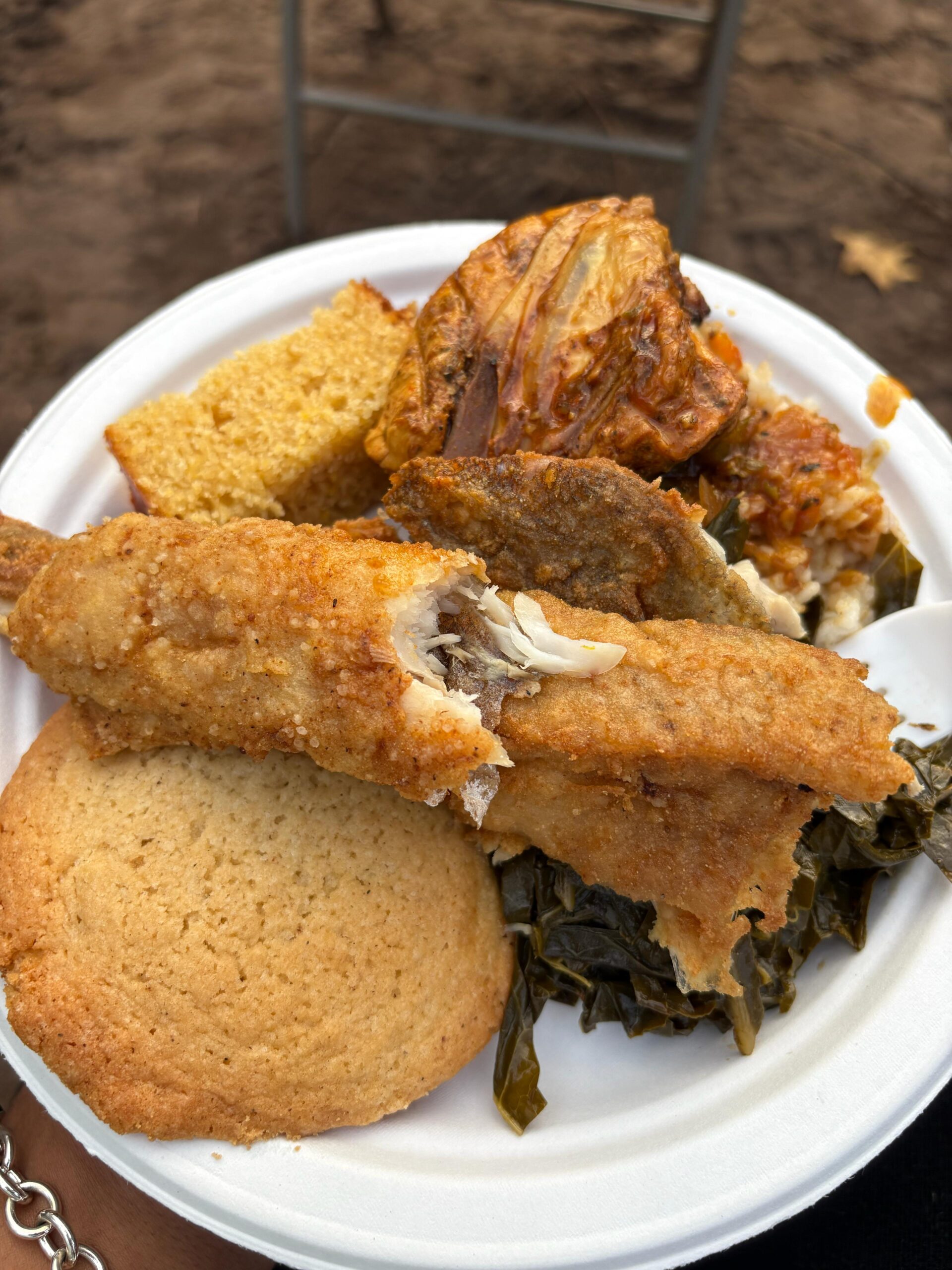
I felt that when I bit into the tea cakes offered last night. It’s pillowy soft and subtly sweet. It’s perfect! From my understanding, enslaved folk all over the South prepared it using very minimal ingredients: flour, egg, molasses, and butter. The one from last night had a lil lemon (and vanilla, I’m sure) too. The recipes were passed down by word of mouth but only some places like Louisiana kept it popular in Black households. Although I’m from Louisiana, from the North to the South, last night was my first time having tea cake, but my DNA recognized it immediately!
We talk about “home” like it’s a place on a map, but the older I get, the more I realize home is really a feeling of being known, being understood, being seen, being shaped.
A few days ago, I saw a video of an Iranian woman living in America whose friends surprised her by making Shirini Danmarki, an Iranian dessert. The moment she tasted it, she cried. To be loved is to be seen, and that’s what she experienced in that first bite. They didn’t just see her as their Middle Eastern friend. They honored where she was from, who raised her, and what flavors shaped her childhood. That dessert said, “I see you, I appreciate you, and here’s one way I can demonstrate that within my capacity.”
It reminded me of an Uber ride I had in Vegas a couple weeks ago with Raza, a driver from Pakistan. “But I’ve been living in America for a very long time. I’m American now,” he clarified. I asked if he visits home often. He said he has no family left there. “When we miss home, it’s usually our people and the food that we miss most,” I answered, thinking about how much I missed my dad and uncle and other family back in Louisiana, and the crawfish boils, beignets, turkey necks, drive-through daiquiris, and Johnny’s Pizza in Monroe.
Raza: I love to cook, so I eat the food all the time! I made lamb for breakfast this morning!”
I asked him how he seasoned it. One of the ingredients was coriander, and he tried describing it.
Me: It’s the seed of cilantro, right?
Raza: Yes!
He LOVED that I was so familiar with the flavors that he called home: tumeric and how it gotta be paired with black pepper to activate the health benefits; mint and how it’ll take over your garden if you ain’t careful; garlic and how we both double down on the amount that any recipe calls for; garam masala and how it has to be added at the end. He suggested I add a lil garam masala to my pot of rice next time, and I promised I would. He LOVED that!
Last night, Chef Twitty put his hands together in a prayer-like gesture and thanked us. He said how hard it can be to be the only one who remembers, who knows why we eat black-eyed peas on New Year’s, put a few peas in your wallet, or why you might wear a penny around your neck for luck. How lonely it can feel carrying traditions no one else around you recognizes anymore. He told us this was one of the best nights of his life. And I believed him.
Because each of these moments—the Iranian woman with her dessert, Raza with his spices, the okra circle on St. Helena, the Amish community pressing cane—wasn’t actually (or only) about food. It was about belonging and how important it is to belong and feel seen. For folk to see and respect you and where you from, your generation, your migration history, your name, your food, and your language.
We can both be Black, but if we ain’t of the same generation, you gotta few more cultural layers that I don’t understand. If we ain’t from the same city (and neighborhood), there go some more layers. If my family deeply rooted here but your grandparents migrated here, more layers. And it goes on and on (and on and on).
The heart of culture is what goes in your mouth (foodways) and what comes out (language). And to see and respect is to wanna know, first off, not necessarily to already be aware. That’s why Krak Teet’s work is all about asking, recording, and sharing. So that we can remember and we can connect and build/sustain community a lil easier.