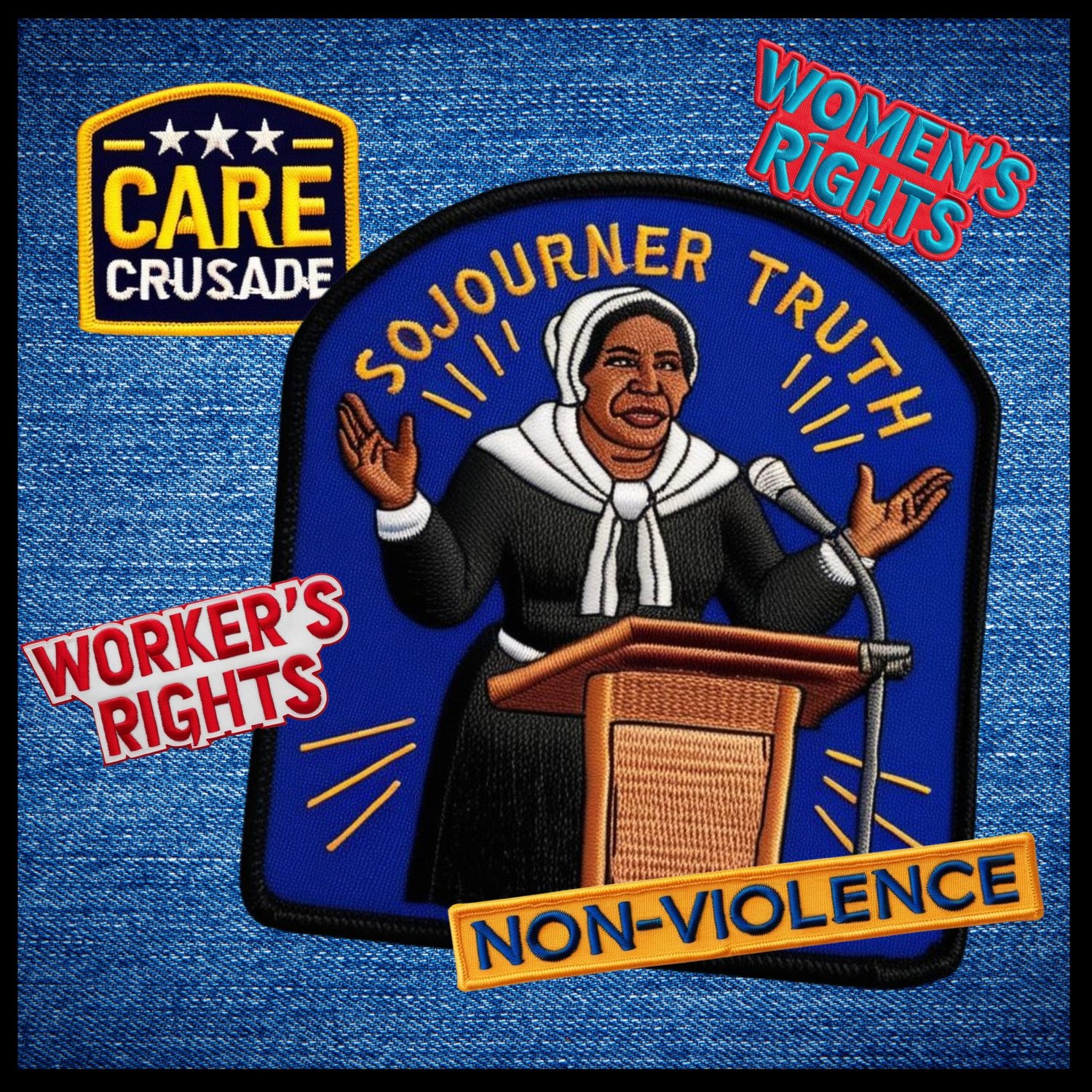
This week, we celebrate caregivers, the ones who step into every gap, fight for our loved ones when no one else will, and remind us: care begins with believing we deserve it.
Sojourner Truth embodied that fierce devotion. When her son was illegally sold into slavery, she prayed, she marched through courtrooms, and she declared: “I have no money, but God has enough—or what’s better! And I’ll have my child again.”
Her faith wasn’t passive. It guided every step of her escape plan: “I told God I was afraid to go in the night, and in the day everybody would see me. Then the thought came—I could leave just before daybreak… ‘Thank you, God, for that thought!’”
She moved at dawn, carrying her infant and the only provisions she owned, trusting divine guidance over human promises. And she knew the heartbreak of broken promises all too well:
“The slaveholders are TERRIBLE for promising to give you this or that… and when we think it is almost in our hands, find ourselves flatly denied!”
We also hear that frustration in her famous speech, “Aren’t I A Woman?” For context, the “Ain’t I A Woman?” speech has been debated for years. Some say she never used those exact words, that her first language was Dutch, and that the phrasing may’ve been altered to mimic Southern Black speech. Still, the heart of the speech remains: she was fed up with being overlooked, overburdened, and under-cared for.
That tends to be the legacy that many caregivers inherit.
Sojourner’s story was one that I didn’t know well. I think I heard her name so often, for every single Black history month in school coming up, that I’m just now circling back with the realization that I really don’t know nothing bout her except she escaped from slavery and made that famous speech.
In 1850, her autobiography was published, titled “The Narrative of Sojourner Truth.” It was dictated by Sojourner Truth then edited by a man named Olive Gilbert.
Here are a few takeaways I’m still sitting with after reading her story:
Caregiving is an act of sovereignty.
When systems fail, you become your own advocate—and sometimes, you must become your own salvation.
Them people have been and still are playing in our face.
Sojourner wrote about her father’s “good funeral” after a lifetime of service: black paint for the coffin and a jug of liquor. Sound familiar? I think of a reel my kids shared of a man who worked 40 years at a company, and they gifted him… 40 sausage rolls.
Then there was the time Sojourner’s enslaver promised to free her on July 4, 1827 if she’d do well and be faithful. She did, even did a season’s extra of work with an injured hand, only to have that man come back and say that injured hand prevented her from upholding her part of the deal so the deal was off. After bragging her whole life ‘bout how her labor was worth more than a handful of men, all of a sudden, it wasn’t good enough.
Know what you came for and be 10 toes down about it.
When her attorney told her, “At least you’ll get $300 if your son isn’t returned—that’s enough for a heap of children,” she wasn’t moved. She didn’t want a settlement. She wanted her son. I wish I could go back and tell 17-year-old Trelani, 21-year-old Trelani: you deserve a birth experience that feels sacred, not rushed. Providers who know your name, say it right, and make you feel seen.
Receiving care is also resistance.
Sojourner’s allies offered her a bed. For days, she slept on the floor—because she didn’t feel worthy. I think about women around me who give so much and reject care when it’s offered. Sometimes that refusal is a shield, but sometimes, it becomes self-neglect. Refusing care doesn’t just block pain—it blocks restoration too.
When Sojourner finally got in that bed—that high, clean, white bed—she did it not just for herself, but for what it meant to be held in dignity. Receiving care is a radical act when you’ve been taught to survive without it.
Caregivers need care, too.
Whether you’re caring for a child, an elder, your organization, your church—it’s a lot. And caregiving is often just a fraction of your to-do list. I interviewed two artist-caregivers a few years ago, Laura Gadson and Shimoda Donna Emanuel. Both were caring for their mothers while still creating. Laura said what helped most was having each other. Someone to talk to. Someone who got it. That, too, is a kind of self-care.