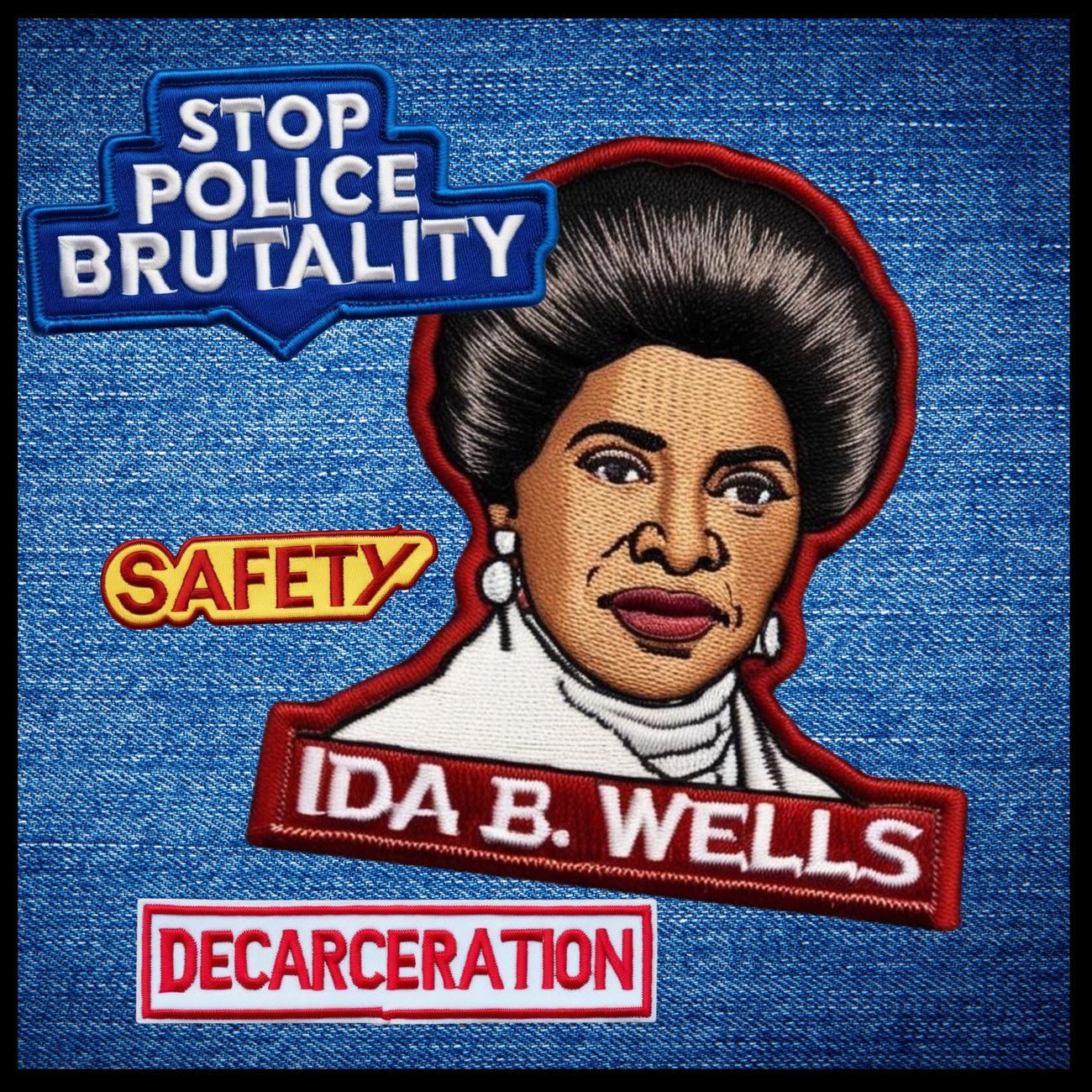
Ida B. Wells knew that the state wasn’t built to protect us. That we had to protect each other, and ourselves.
She once said:
“A Winchester rifle should have a place of honor in every Black home, and it should be used for that protection which the law refuses to give.”
Ida understood that protection was a right, not a privilege. And that justice had to be rooted in both truth and readiness. That spirit runs through Zora Neale Hurston, too.
In 1927, Zora drove through the Deep South collecting folklore usually alone, in a car she named Sassy Susie. She wore a pistol for protection. There’s a picture of her taken in Mobile, Summer of 1927 with a pistol under her left arm, hands on her wide, low-slung ammunition belt, head cocked under a wide-brimmed hat, white dress and stockings. Smizing like she knows you can’t stop her. Because you couldn’t.
Zora and Ida didn’t romanticize danger. They carried their own safety. For various reasons, they knew they could be a target in these environments they were entering. And the first law of nature is self-preservation.
But let’s go deeper.
Zora’s hometown—Eatonville, Florida—was one of the first all-Black incorporated towns in the U.S. In Mules and Men, she described it like this:
“Eatonville, Florida, City of Five Lakes, Three Croquet Courts, 300 Brown Skins, 300 Good Swimmers, Plenty of Guavas, Two Schools, and No Jailhouse.”
No jailhouse.
And it wasn’t just Eatonville. Many Black towns back then operated without jails—not because they were lawless, but because they were loving. They corrected each other. They created safety through relationship, not surveillance. In the spirit of Sankofa, we gotta go back and reclaim that for ourselves and our communities.
But true safety starts before all of that. It starts in childhood.
In Jonah’s Gourd Vine, Zora’s first novel, released in 1934, she dropped this gem through one of the characters:
“We Black folks don’t love our chillun. We couldn’t do it when we wuz in slavery… Dey b’longed tuh old Massa. ‘Twan’t no use in treasurin’ other folkses property… But we’s free folks now. De big bell done rung!… Us got tuh ‘gin tuh practise on treasurin’ our younguns… Ah don’t want ‘em knocked and buked.”
That hit me hard.
Because how we treat our children is a direct reflection of what we believe we deserve.
If we expect punishment from the world—or from God—we tend to pass that down.
But if we believe we are worthy of protection, we’ll build systems that protect. And teach our children—and our own inner child, our inner lil girl, our 8 and 13 and 16 year old selves—that safety isn’t earned. It’s owed.
I first heard about decarceration from The Black Panther Party. In their ten-point program, number 8 demands that all Black people be released from jails and prisons because, inherently, they have not received a fair and impartial trial. About 10 years ago, I took some students to Detroit and we learned about their efforts in abolishing prisons. It blew my mind.
Then last year, I met Curtis Renee, director of The Detroit Safety Team. They help communities build safety infrastructures that don’t rely on police, but instead centers care, accountability, and healing. All of these entities—from Eatonville to Detroit—remind me that a future of decarceration is not fantasy. It’s happened before, and it can happen again.
But only if we believe we’re worth the safety we’re fighting for.