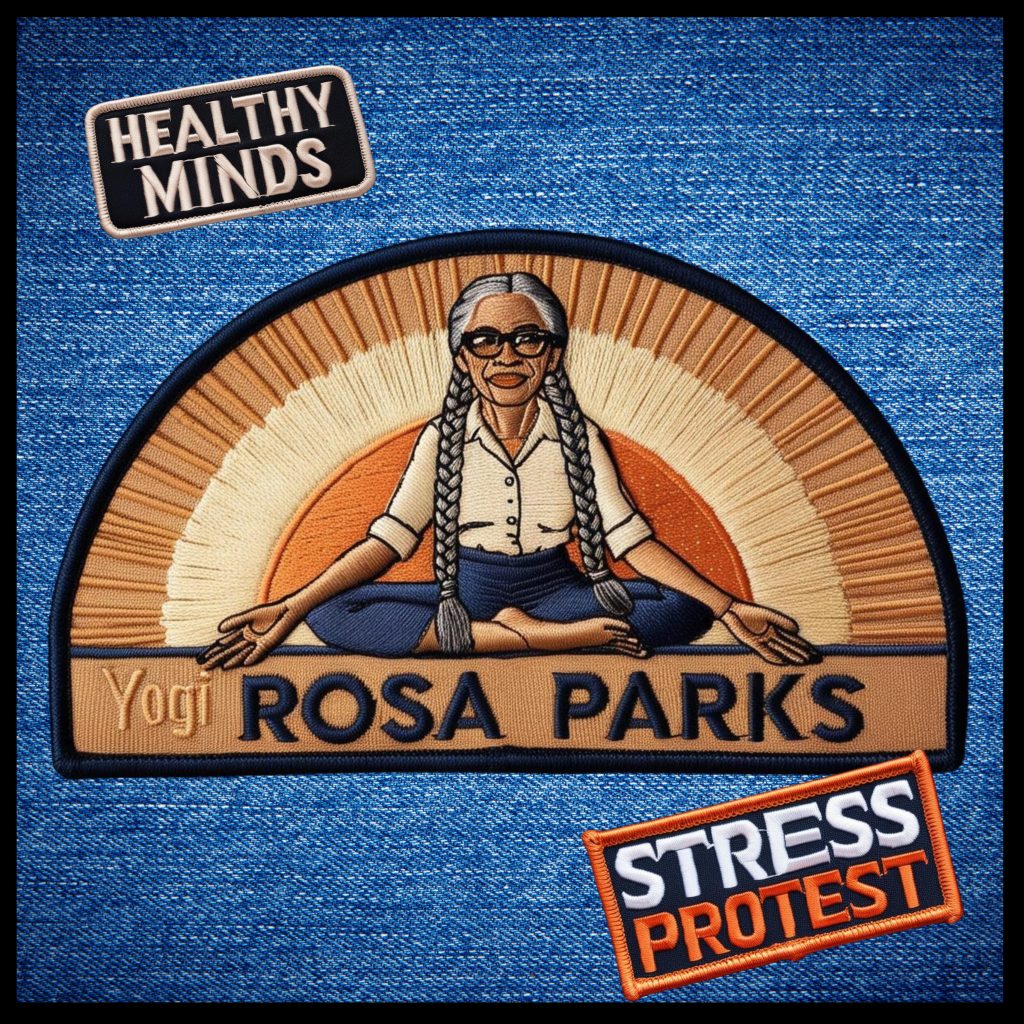
When we talk about meditation, prayer, breathwork—sometimes we picture folks sitting cross-legged, humming “om,” or deep in yogic stillness. Although the pics of Rosa Parks practicing yoga are some of my favorites, for many of our foremothers, mindfulness looked a little different.
It looked like sitting on the porch and watching the world pass by, rocking gently in rhythm with their thoughts. It looked like closing their eyes and saying, “I’m just resting ‘em,” but really they were doing what we now call mindfulness—just being with themselves. It looked like shelling peas, quilting, basket-making, cake baking, pulling weeds. These were sacred rhythms that quieted the mind, regulated the breath, and opened space for gratitude, clarity, and prayer.
And we pray to give thanks. to ask for something. And sometimes, to just vent. A good “Lord, have mercy!” carried so much weight—it could be a full prayer in itself. It didn’t matter what your belief system was, or even if it didn’t have a name. The act of turning inward or upward—of reaching for something bigger than yourself—that was spiritual practice.
That’s why I love this moment in Parable of the Sower by Octavia Butler. Travis, a young boy, says:
“Prayer makes people feel better, even when there’s no action they can take.”
And Lauren, the protagonist, responds that people forget ideas, but they remember God—especially when they’re scared or desperate. She says, “They reach back to the Bible, the Talmud, the Koran, or some other religious book that helps them deal with the frustrating changes that happen in life.”
That’s powerful, because it shows that across all religions, cultures, and traditions, the impulse is the same: to find grounding, to feel seen, to not face the unknown alone.
But even with all that wisdom around us, healing still takes time. In The Salt Eaters, Minnie Ransom, a healer, tells Velma—who’s struggling to come back from the brink:
“I can feel, sweetheart, that you’re not quite ready to dump the shit…got to give it all up—the pain, the hurt, the anger—and make room for lovely things to rush in and fill you full. Nature abhors a so-called vacuum…But you want to stomp around a little more in the mud puddle… Nothing wrong with that…I can wait.”
That part always stays with me. It reminds us to give ourselves grace when we’re not ready yet or when we’re “off track.” And to give others that same grace when they’re still wrestling with their pain. Healing isn’t a race. It’s a return—to self, to softness, to community.
Alice Walker captures that communal piece so beautifully in The Temple of My Familiar, which is kind of a spin off from The Color Purple.
Mama Shug, now an elder, opens her home as a sanctuary. People come from all walks of spiritual life—some worship trees, some worship air, some Isis. But the point isn’t what they worship. It’s that they come together to do it. And, inspired by the West African tribe that Celie’s daughter grew up around, Shug’s church refers to G-O-D as a sound, a hum. “Ommm.” Ain’t that familiar? Celie’s granddaughter described the church, saying: “Everyone who came brought information about their own path and journey. They exchanged and shared this information. That was the substance of the church.”
That’s church. kinship. collective healing.
Meditation ain’t new to us. Prayer ain’t new to us. Gratitude ain’t new to us. Our people been doing this. In gardens. On porches. In kitchens. In song. In silence. In community. The goal ain’t the perfect wording, the perfect posture, or timing. The goal, as our foremothers taught us, is being present, being yourself, and having grace.
Self-Care School is a 10-week podcast series by GirlTREK. Every Friday features Trelani Michelle, sharing elder/ancestral wisdom through personal observation and book excerpts.